2026 Corporate Gifting Trends: What North American and European Buyers Want
Corporate gift buyers are not simply looking for more products in 2026. They are trying to create more value with a controlled budget: fewer forgettable giveaways, more useful merchandise, stronger presentation and clearer proof behind quality or sustainability claims.
That shift is visible in both North America and Europe, although the product mix and programme priorities are not identical. This guide turns the latest corporate gifting trends for 2026 into practical decisions for HR teams, marketing managers, event planners and procurement buyers.
The 2026 Demand Signal: Fewer Gifts, Better Reasons to Keep Them
The strongest demand signal is not a single product category. It is a higher standard for usefulness and perceived value.
The PPAI Product Power 2026 study, based on more than 5,000 US respondents, found that 83% said receiving a promotional product made them feel appreciated and 90% said it improved their perception of the brand. Nearly two-thirds said they were very likely to keep a branded product for at least six months, with durability, design and material among the reasons.
This is US consumer research, so it should not be presented as a direct measure of European preferences. However, a separate business-programme study shows a similar decision pattern across both regions. The Incentive Research Foundation’s 2026 outlook, covering 200 respondents in North America and 200 across seven European countries, says organisations continue to prioritise usefulness, budget alignment, personalisation and meaningful impact in event gifting.
The practical conclusion is simple: a larger box does not automatically create a better gift. Every item needs a role in the recipient’s routine, and the complete set needs a clear reason to exist.
How North American and European Corporate Gift Demand Compares
| Demand area | North America | Europe | What buyers should do |
|---|---|---|---|
| Use of merchandise rewards | 84% of surveyed organisations include merchandise; 54% expect to increase its use. | 70% include merchandise; 46% expect to increase its use. | Keep merchandise in the programme, but give each item a defined audience and purpose. |
| Average merchandise reward | The reported average per-instance spend rose to $276. | The reported average rose to €306. | Compete through perceived quality and presentation, not item count alone. |
| Leading categories | Food gifts, electronics and apparel are prominent. | Food gifts lead, followed by electronics; apparel and office accessories also feature. | Use a core concept, then localise the mix rather than assuming one global box fits every team. |
| Event gifting | Budgets remain cost-conscious, with evidence of higher spend on fewer individual gifts. | The same cost pressure and selective approach appear in European programmes. | Segment VIPs, speakers, employees and general attendees before setting quantities. |
The figures do not mean every European buyer wants food or every North American buyer wants electronics. They show where demand is concentrated and why a regional brief is more useful than a generic “international gift” request.
Five Corporate Gifting Trends Buyers Can Act On
1. Everyday usefulness is the entry requirement
Useful does not have to mean plain. It means that the recipient can immediately understand where the product fits: a tumbler for a commute, a notebook for meetings, a power bank for travel or a bag for carrying work essentials.
ASI’s 2026 Ad Impressions Study found that T-shirts led the promotional products its respondents were excited to receive, followed by categories including fleece and jackets, food gifts, blankets, drinkware and bags. The lesson is broader than the ranking: familiar categories still perform when the design and quality make them desirable.
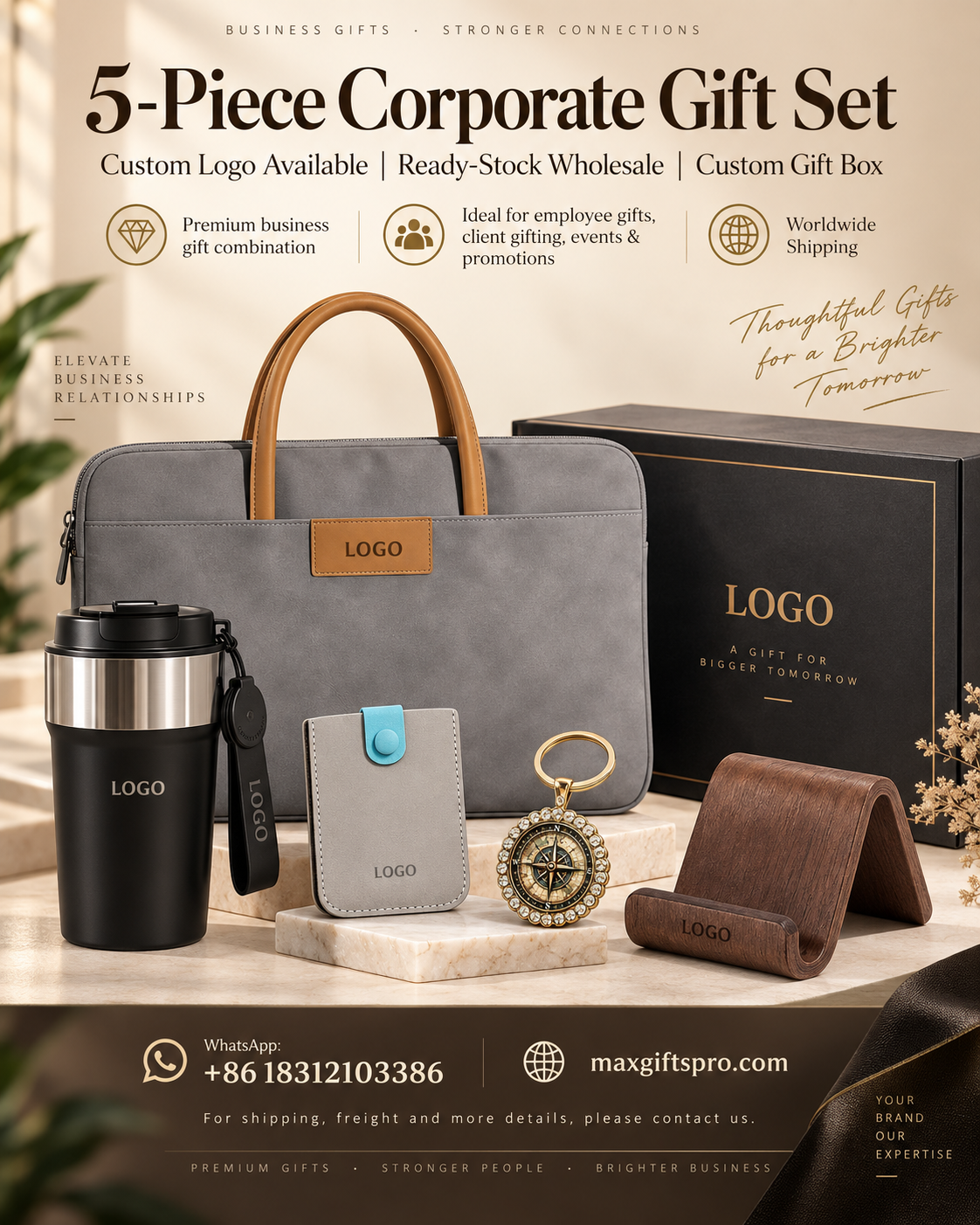
For a workday-oriented programme, a custom A5 notebook gift set can connect writing, drinkware and presentation in one brief. For commuting or business events, a custom corporate backpack provides a different type of daily utility. Confirm the exact materials, dimensions, components and branding before ordering.
2. A smaller, coordinated set can beat a box of fillers
Current budget pressure does not remove demand for corporate gifts; it makes the product mix more selective. The IRF found that average event-gifting spend per person declined in both regions while per-instance merchandise spend increased. Its interpretation is that organisations are reducing the number of gifts or recipients in some programmes while trying to make each selected gift more appealing.
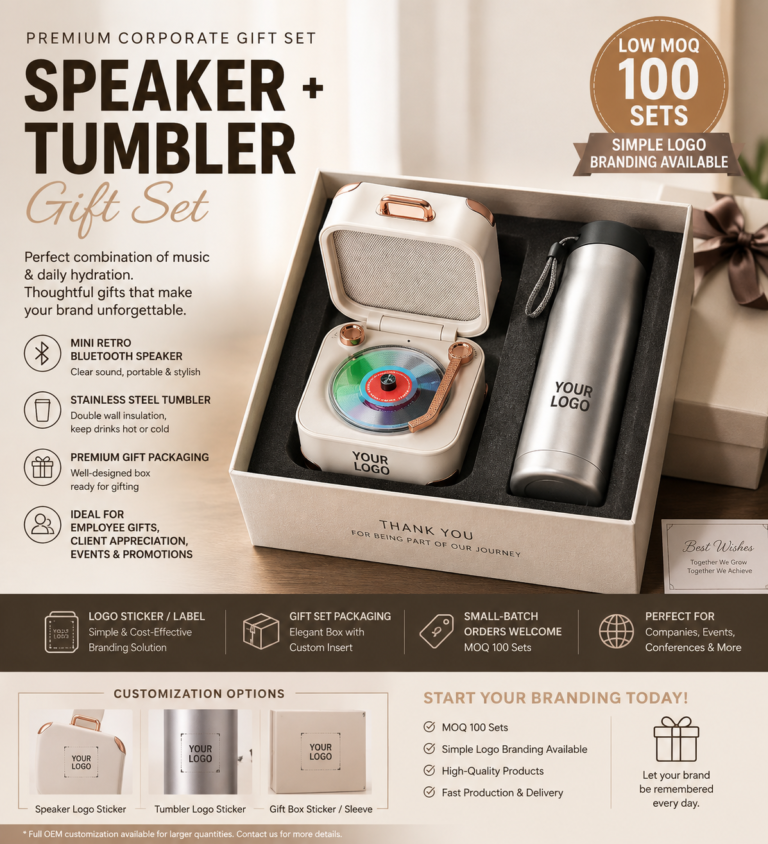
Build a set around one use case instead of filling every available space. A notebook, pen and tumbler can support planning and daily work. A phone stand, wireless mouse, power bank and tumbler can support a hybrid desk and travel routine. The 4-piece corporate gift-set guide shows how that second combination can be briefed for employee and client programmes.
3. Personalisation is moving beyond putting a logo everywhere
Personalisation begins with relevance. A gift selected for a new employee should not use the same message as a client thank-you or conference speaker gift. Separate the audience first, then decide whether personalisation belongs on the product, the gift box, a sleeve or an insert card.
Restraint often improves continued use. Put the company mark on one or two logical surfaces and use packaging to carry the campaign message. If the date or event name is temporary, place it on a removable card rather than permanently printing it across the main product.
4. Sustainability claims need evidence
PPAI’s 2026 research reports that sustainability influences whether many US consumers keep or use a product, while requests for testing, material information and ESG documentation are also increasing among industry buyers. This creates an important distinction: “eco-friendly” wording is not a substitute for a product-specific specification.
Ask what material is used, what percentage is recycled where a recycled-content claim is made, which test or certification supports the claim and what packaging will accompany the product. Requirements vary by destination and product type, so request documentation for the exact configuration being ordered. Do not copy a compliance statement from a similar-looking item.
5. Delivery planning is part of the gift
A well-chosen product can still fail if it arrives after the event, at a closed office or in packaging that does not suit the handover. International campaigns need a distribution plan as well as a product plan.
Define the required in-hand date, destination countries, receiving contacts, number of delivery points and whether the sets will be distributed centrally or sent to individuals. Then allow time for the quotation, artwork, proof, sample, production, quality checks and transport. Ask for a project-specific schedule rather than relying on a general lead-time claim.
Choose the Gift Format by Audience
| Audience | Useful direction | Briefing priority |
|---|---|---|
| New employees | Notebook, drinkware, desk technology or a work bag. | Make the set useful during the first week and keep the welcome message personal. |
| Distributed teams | Size-neutral desk, travel or drinkware products. | Plan address collection, privacy, regional delivery and replacement handling. |
| Clients and partners | A compact premium set, coffee gift or practical technology. | Check the recipient organisation’s gift policy and keep branding restrained. |
| Conference speakers and VIPs | A higher-value focused set rather than a general attendee swag bag. | Consider portability, handover timing and a personal thank-you card. |
| Large event audiences | One useful hero item or a simple two-piece set. | Control unit cost, packing volume and on-site distribution. |
If no existing set matches the audience, start with the recipient’s routine and build a custom corporate gift set. A clear use case makes it easier to remove unnecessary products and coordinate the colours, branding and packaging.
A 2026 Corporate Gift Briefing Checklist
- Recipient group, occasion and intended use.
- Required quantity, including approved spare units.
- Target budget for the complete delivered gift.
- Preferred products and any items that should be excluded.
- Logo artwork, brand colours and desired level of brand visibility.
- Personalisation, card, insert and language requirements.
- Material, testing, origin or sustainability documents required by the buyer.
- Gift-box, protective packing and outer-carton requirements.
- Destination countries, delivery points and receiving contacts.
- Required in-hand date and named artwork approver.
Turn Current Demand Into a Better Gift Programme
The corporate gifting trends shaping 2026 point in one direction: choose products people can use, give the set a clear purpose and make quality visible through design, packaging and accurate specifications. North American and European programmes differ in category emphasis, but buyers in both regions are balancing personalisation and impact with disciplined budgets.
Request a custom corporate gift quotation from MaxGiftsPro. Share the audience, quantity, destination, target budget and required date. The team can help compare product combinations, logo options and packaging for your programme.